Scientific Rationale
Bacterial quorum sensing represents a key regulatory system that enables microbial populations to coordinate collective behaviours in response to cell density. Among the different quorum sensing pathways, the autoinducer-2 (AI-2) system is particularly relevant due to its role as a universal interspecies signaling mechanism.
The AI-2 signaling cascade controls a wide range of processes associated with bacterial pathogenicity, including virulence factor expression, biofilm formation, and host adaptation. Its central and conserved role across both Gram-positive and Gram-negative bacteria makes it an attractive and potentially broad-spectrum target for antivirulence strategies.
Within this framework, targeting quorum sensing offers the opportunity to interfere with bacterial coordination mechanisms without directly affecting cell viability, thereby potentially reducing the emergence of resistance.
Molecular Targets – LsrK kinase
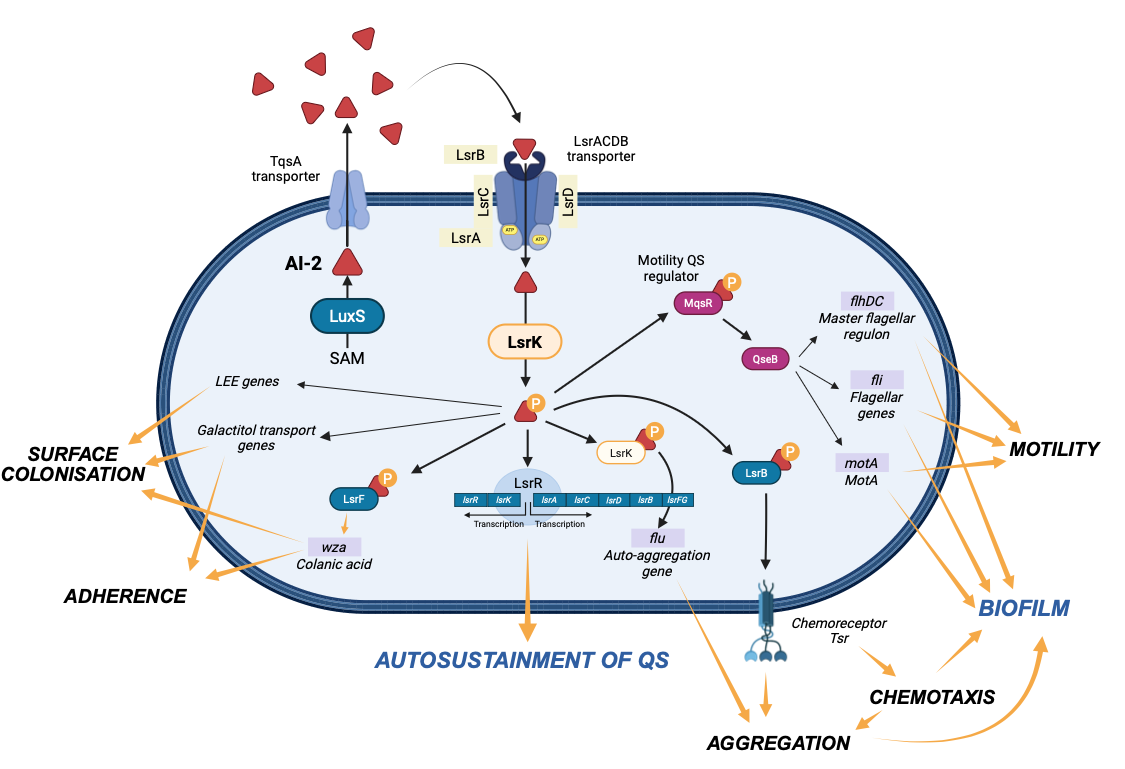 The project focuses on key proteins involved in the AI-2 signaling pathway, with particular attention to targets responsible for signal production, processing, and intracellular response.
Among these, the project investigates components of the AI-2 processing machinery, focusing on kinases LsrK, which play a pivotal role in signal internalization and downstream regulation.
By targeting multiple nodes within the signaling cascade, the project aims to explore different intervention strategies and identify the most effective points for pharmacological modulation.
Drug Discovery Strategy
The research adopts a structure-based drug design approach to identify small molecules capable of modulating AI-2 mediated signaling.
Computational methods are used to explore the structural features of target proteins, identify potential binding sites, and design novel ligands. These approaches include molecular docking, molecular dynamics simulations, and binding free energy estimations, which together support the rational optimization of candidate compounds.
On the experimental side, synthetic efforts are directed toward the generation of focused compound libraries inspired by both substrate-like structures and novel chemotypes emerging from computational screening. Particular attention is given to the exploration of chemical space compatible with target recognition while maintaining favorable physicochemical properties.
Experimental Validation
Candidate molecules are evaluated through a combination of biochemical, biophysical, and microbiological assays.
Biophysical techniques are employed to characterize protein–ligand interactions and validate binding hypotheses derived from computational studies. In parallel, microbiological assays are used to assess the ability of compounds to modulate quorum sensing-dependent phenotypes, including biofilm formation and virulence-related behaviors.
Importantly, the project prioritizes the identification of compounds that affect bacterial pathogenicity without significantly impacting bacterial growth, in line with the antivirulence paradigm.
Toward Antivirulence Therapeutics
By integrating computational design, chemical synthesis, and experimental validation, the project aims to establish a robust framework for the discovery of small-molecule modulators of bacterial communication.
This research contributes to a growing effort to move beyond traditional antibacterial strategies and toward innovative therapeutic approaches that target the regulatory networks underlying bacterial pathogenicity. Such strategies may ultimately provide more sustainable solutions to the challenge of antimicrobial resistance.
Bibliography
- World Bank, Drug-Resistant Infections: A Threat to Our Economic Future (Final Report), World Bank Rep. (2017) 1–132.
- S. Nadar, et al., Development of Antibiofilm Therapeutics Strategies to Overcome Antimicrobial Drug Resistance, Microorganisms. 10 (2022) 303.
- A. Ghosh, et al., Small-Molecule Inhibition of Bacterial Biofilm, ACS Omega. 5 (2020) 3108–3115.
- M. Whiteley, et al., Progress in and promise of bacterial quorum sensing research, Nature. 551 (2017) 313–320.
- P. Linciano, et al., Tackling Antimicrobial Resistance with Small Molecules Targeting LsrK: Challenges and Opportunities, J. Med. Chem. 63 (2020) 15243–15257.
- S. Stotani, et al., A versatile strategy for the synthesis of 4,5-dihydroxy-2,3-pentanedione (DPD) and related compounds as potential modulators of bacterial quorum sensing, Molecules. 23 (2018) 2545.
- S. Stotani, et al., DPD-Inspired Discovery of Novel LsrK Kinase Inhibitors: An Opportunity to Fight Antimicrobial Resistance, J. Med.Chem. 62 (2019) 2720–2737.
- V. Gatta, et al., A New Cell-Based AI-2-Mediated Quorum Sensing Interference Assay in Screening of LsrK-Targeted Inhibitors, ChemBioChem. (2020) 1–6.
- P. Medarametla, et al., Structure-Based Virtual Screening of LsrK Kinase Inhibitors to Target Quorum Sensing, ChemMedChem. 13 (2018) 2400–2407.
- P. Medarametla, et al., Structural Characterization of LsrK as a Quorum Sensing Target and a Comparison between X-ray and Homology Models, J. Chem. Inf. Model. 61 (2021) 1346–1353.